Marching cubes
Marching cubes turns a scalar field into a triangle mesh. The usual way to show it is a
Result
| ground truth | closed form — sphere `4/3·π·r³`, `4·π·r²`; torus `2·π²·R·a²`, `4·π²·R·a` |
| grids | 16³ to 128³, seven resolutions |
| variants | `lewiner`, `lorensen` |
| measurements | volume error, area error, vertex distance to the true surface, time |
The finding
The error is exactly second order, and that fixes the cost
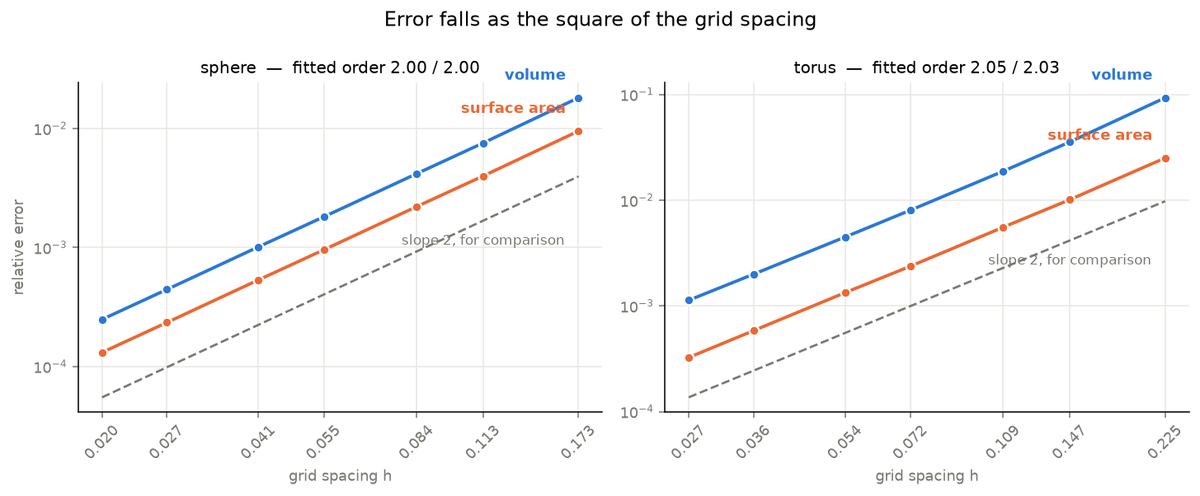
Fitting log(error) against log(h) gives the observed order of convergence:
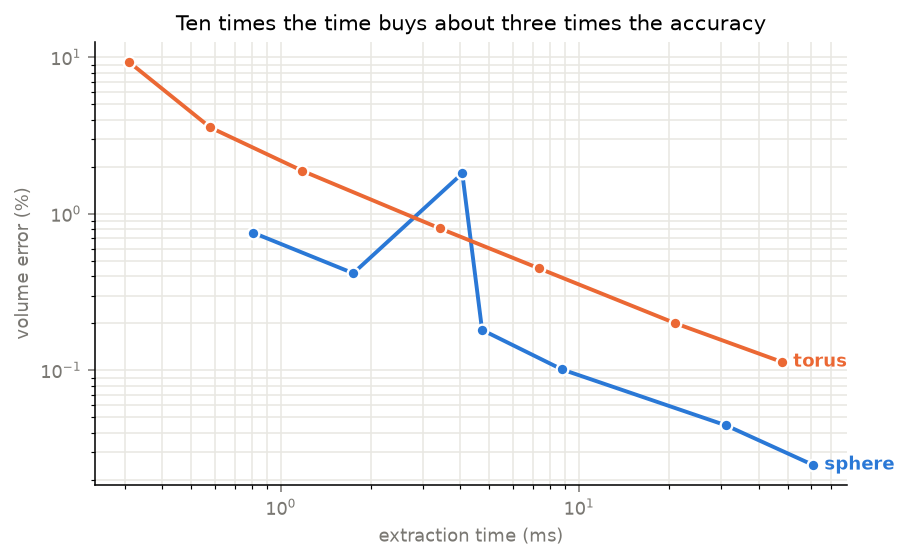
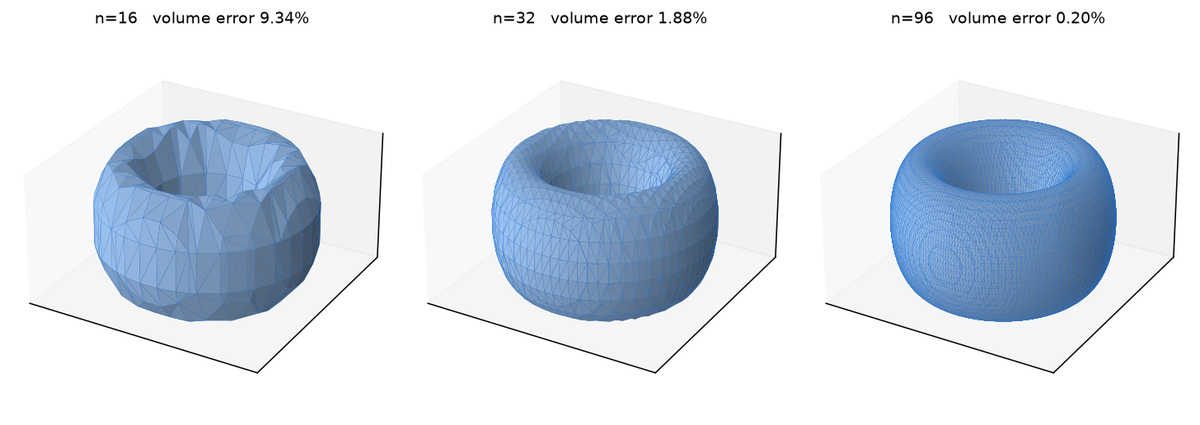
All six fits land within 0.05 of 2.00. Halving the grid spacing quarters the error — and costs eight times the memory and roughly six times the time. That is the whole trade, and it means accuracy here is bought at a known, unflattering rate: **ten times the time buys about three times the accuracy**, not ten.
Vertex distance converging at the same order as volume is the useful check. If the mesh were in the right place but the wrong size, the two would disagree.
Figures
Elsewhere
Code and full results on GitHub
Every number is read from the file the run produced. github.com/hammasbuilds · kaggle.com/muhammadhammas13