Point cloud decimation
Three ways to throw away points — **voxel grid**, **farthest-point sampling** and
Result
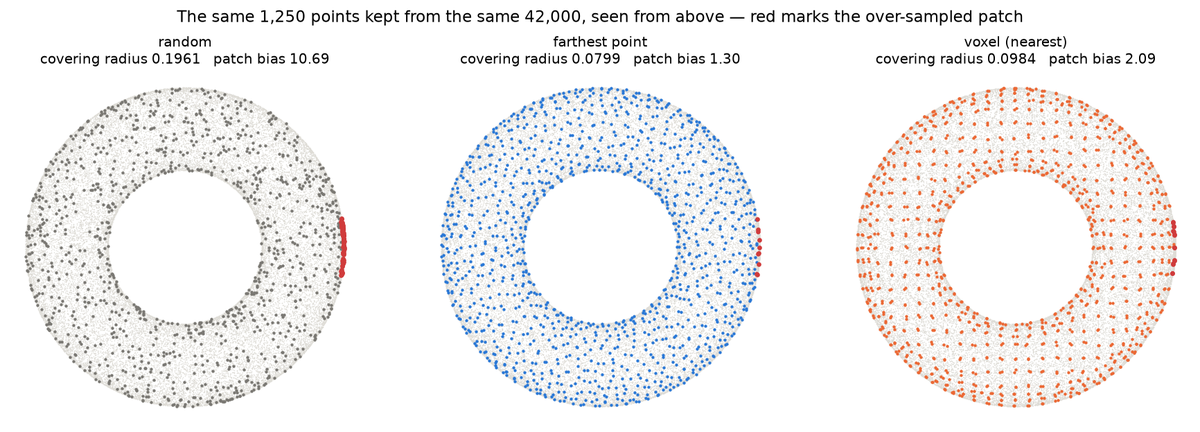
| cloud | 42000 points on a torus (R = 1, a = 0.35), of which 2222 lie in an over-sampled patch |
| planted ground truth | the patch's area is `a·2wu·(R·2wv + a(sin(v0+wv) − sin(v0−wv)))` = 0.08482102920624893, a 0.61% share of the surface; the input holds 5.2904761904761906% of its points there, a bias of **8.618248400757404** |
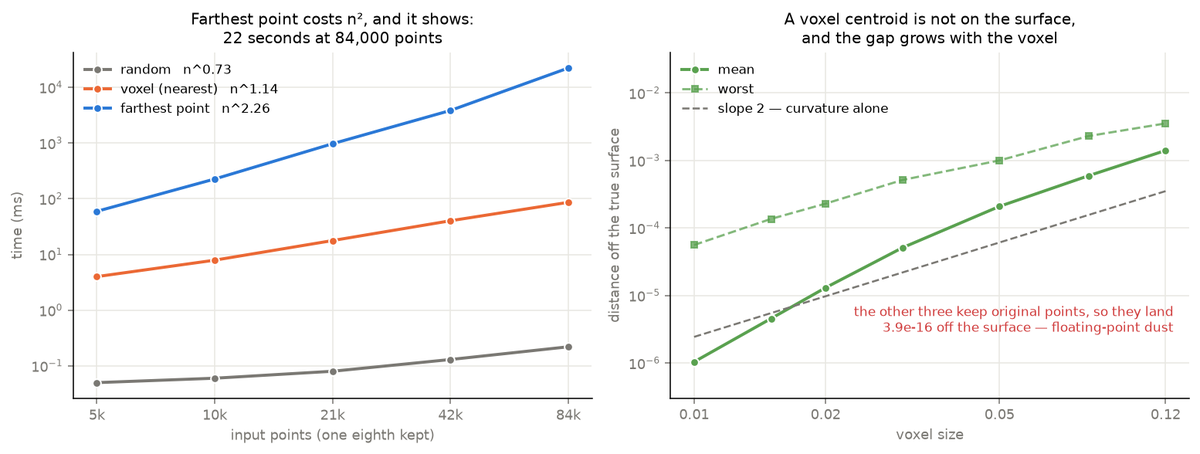
| measured | Chamfer back to the original, covering radius, distance off the true surface, density bias, wall clock |
| retained | 300 to 20000 points, matched across methods by bisecting the voxel size |
The finding
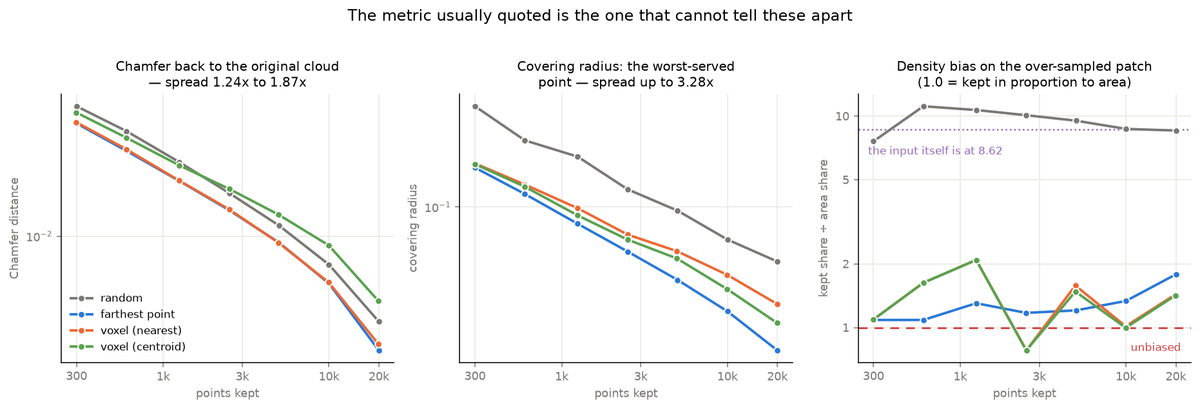
The metric usually quoted is the one that cannot tell these apart
Chamfer distance back to the original cloud is what decimation is normally scored on. Across every matched count, the spread between the best and worst method on that metric is between 1.24× and 1.87×. On covering radius — the largest distance from any original point to its nearest kept point — the same four methods differ by up to 3.28×, and on density bias by nearly 10×.
Chamfer is a mean over every point, so a handful of badly served regions barely move it. The covering radius is the worst case, and the worst case is what decides whether a later surface fit, normal estimate or collision test has anything local to work with.
Figures
Elsewhere
Code and full results on GitHub
Every number is read from the file the run produced. github.com/hammasbuilds · kaggle.com/muhammadhammas13