Surface reconstruction
Four classical reconstruction methods are run on points sampled from an analytic
Result
| surfaces | unit sphere, torus (R = 1, a = 0.35) | ||
| ground truth | ` | sdf | ` at area-weighted samples of the output triangles; `V − E + F` |
| methods | convex hull · alpha shape (3-D Delaunay) · Hoppe tangent plane · Poisson (FFT) | ||
| varied | 500–8000 points, noise σ = 0 to 0.04, alpha, grid resolution | ||
| normals | estimated by PCA and oriented by spanning-tree propagation — not given |
The finding
The convex hull is the most accurate method on the sphere and the only one that cannot be fixed on the torus
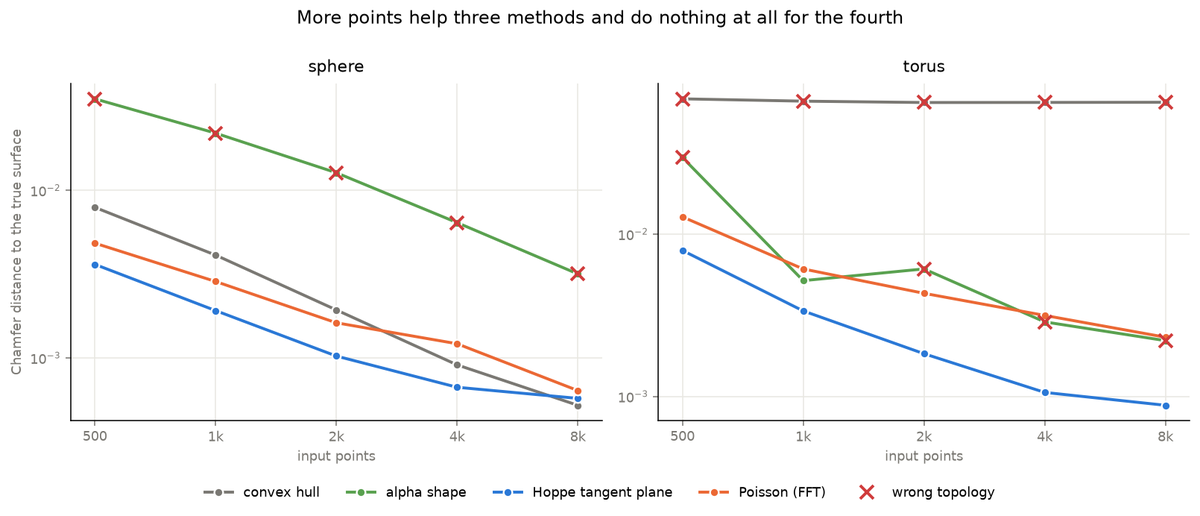
On a convex surface the hull converges as n^−1.00 — faster than every other method tested, and at 8000 points it is the most accurate of the four (0.00052) while taking 18.1 ms against Hoppe's 782.1 ms.
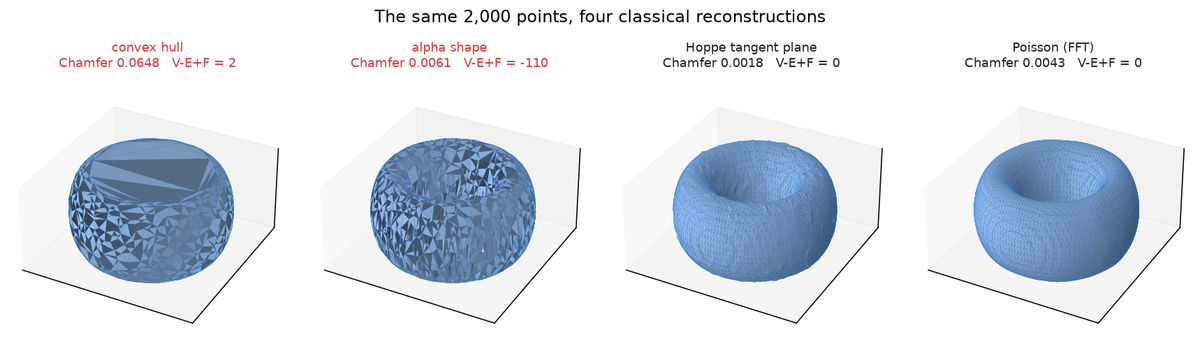
On the torus the same method is stuck at 0.065 and **sixteen times more points change it by −4.7%**: the fitted exponent is −0.02, which is a flat line with measurement noise on it. Its Euler characteristic is 2 at every size, because a hull has no way to represent a hole. This is the clean case of a method that is not slowly wrong but structurally wrong, and the exponent is how you tell the two apart without looking at a picture.
Figures
Elsewhere
Code and full results on GitHub
Every number is read from the file the run produced. github.com/hammasbuilds · kaggle.com/muhammadhammas13