Poisson blending
[](https://www.python.org/)
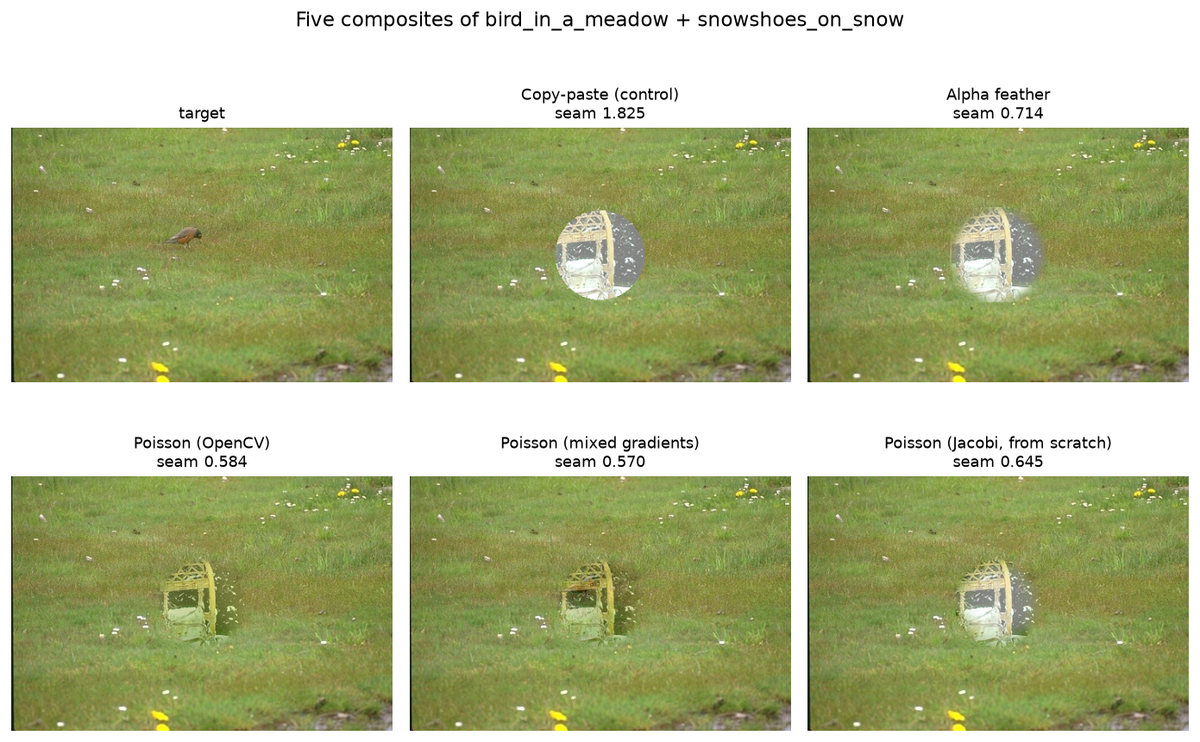
Result
| Sr | Pair | Copy-paste | Alpha feather | Poisson (OpenCV) | Mixed gradients | Jacobi (from scratch) |
|---|---|---|---|---|---|---|
| 1 | bird in a meadow + snowshoes on snow | 1.790 | 0.760 | **0.543** | 0.533 | 0.623 |
| 2 | tent on the ice + bobcat and daisies | 1.626 | **0.700** | 0.885 | 0.823 | 0.842 |
| 3 | wallaby in scrub + spear fisher | 4.519 | **1.179** | 1.286 | 0.866 | 1.207 |
| 4 | stone viaduct + skier mid air | 4.758 | 1.148 | **1.091** | 0.836 | 1.022 |
The finding
The equation, solved twice
` minimise |∇f − ∇source|² inside the region subject to f = target on the boundary `
whose solution satisfies ∇²f = ∇²source. Discretised, every interior pixel is the average of its four neighbours minus the source's Laplacian, so iterating that update converges to the answer.
They agree to 0.0066 — two independent implementations of the same equation, which is the only real check that either is right — and the transparent one costs 38× the time.
Converged by 50 iterations and flat thereafter; the slight rise past 200 is float accumulation in the Jacobi update, not further progress.
### The one line that makes it Poisson blending
`python f = sub.copy() # target everywhere, INCLUDING the boundary ring f[interior] = patch[interior] # a starting guess, interior only `
Seeding the boundary from the source instead — f[region_mask] = patch[...] — makes f = source an exact fixed point of the iteration, because the solution of ∇²f = ∇²g with f = g on the boundary *is* g.
The solver then "converged" in zero steps to the copy-paste answer and reported a seam visibility of **2.8046 — identical to the control, to four decimal places** — with nothing at all to indicate it had not run. It is the quietest failure in this repository: a method that is a no-op, reporting a plausible number, in a table where another row happens to carry the same one.
---
Figures
Elsewhere
Code and full results on GitHub (code private)
Every number is read from the file the run produced. github.com/hammasbuilds · kaggle.com/muhammadhammas13