Demosaicing
[](https://www.python.org/)
Result
| Sr | Scene | Nearest | Bilinear (own) | Bilinear (CV) | **Malvar** | **VNG** | Edge-aware |
|---|---|---|---|---|---|---|---|
| 1 | sea stacks · sat. edges 0.0% | 20.83 | 24.25 | 24.83 | 30.05 | **30.56** | 24.70 |
| 2 | two in headscarves · 2.6% | 24.21 | 30.14 | 30.19 | 36.94 | **36.96** | 30.39 |
| 3 | lynx on birch · 16.6% | 22.12 | 26.60 | 26.73 | 32.26 | **32.30** | 26.61 |
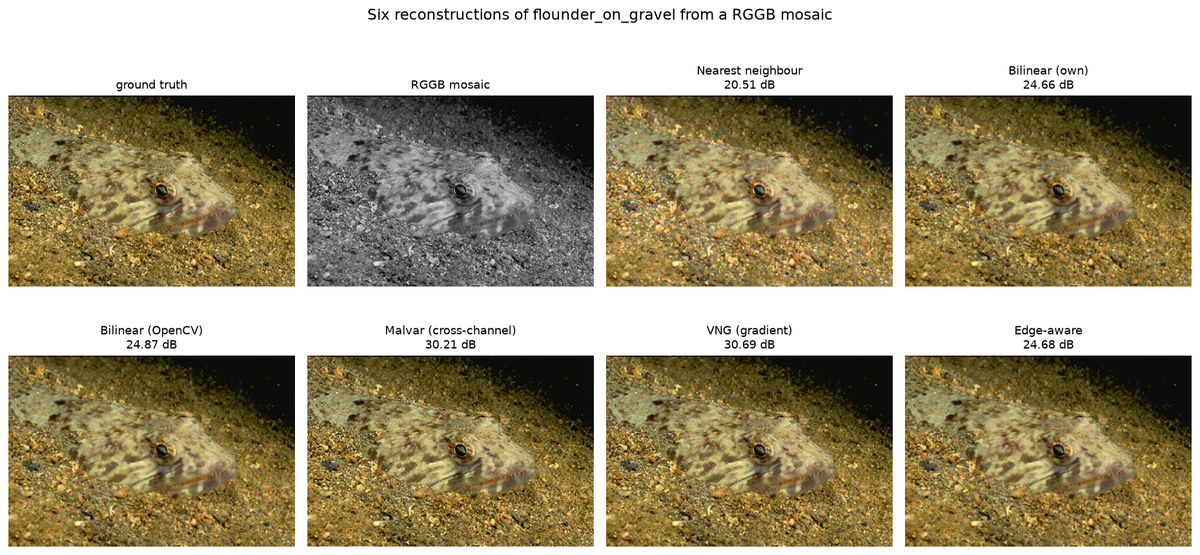
| 4 | flounder on gravel · 71.7% | 20.51 | 24.66 | 24.87 | 30.21 | **30.69** | 24.68 |
The finding
The signature result: whole-image PSNR hides the failure
Every method, without exception. Most of a photograph is smooth, and interpolating a missing colour across a smooth region is trivial — so the whole-image average is dominated by the pixels where the problem does not exist. The failure lives on the 3% of pixels that are edges, and it is 2 to 3 dB deep there.
The colour fringing column is what a viewer actually notices: a magenta or cyan halo on a high-contrast edge, caused by red, green and blue being interpolated to slightly different places. Malvar and VNG cut it roughly in half.
---
Figures
Elsewhere
Code and full results on GitHub (code private)
Every number is read from the file the run produced. github.com/hammasbuilds · kaggle.com/muhammadhammas13